5 Hardware Specs to Check Before Solana Validator Setup
The Solana mainnet does not extend tolerance to validators that cut corners on compute, memory, or storage.
5 Hardware Specs to Check Before Solana Validator Setup
A Solana validator that cannot sustain its leader schedule is functionally absent from consensus, regardless of how much stake is delegated to it.
CPU Architecture and Clock Speed
Solana's Proof of History generator, combined with its transaction processing pipeline, places sustained multi-core load on the validator host. Solana documentation specifies a CPU with at least 12 cores and 24 threads, operating at a base clock of 2.8 GHz or higher. This is not a recommendation that can be safely relaxed: the leader schedule demands deterministic execution of the PoH hash sequence, and any core contention introduced by running a validator on a CPU with fewer cores or lower single-thread performance propagates directly into missed slots.
The clock speed floor matters because several critical paths in the validator — signature verification, transaction scheduling, and the PoH tick producer — are sensitive to single-thread latency. A higher core count without adequate per-core performance does not compensate; conversely, a high-clock CPU with insufficient cores creates queueing under the parallelism the runtime expects. The hardware specs to check before Solana validator setup must therefore be evaluated holistically, not by inspecting a single spec-sheet value in isolation.
In practice, operators should target server-class silicon — AMD EPYC or Intel Xeon families — where the core count and base clock can be delivered simultaneously, and where the motherboard platform supports the memory channel count these workloads require. Consumer desktop silicon, even when the headline core count appears adequate, typically lacks the sustained all-core frequency and the memory bandwidth needed to maintain leader schedule performance under sustained load.
Memory Scaling: The 256GB Floor
A minimum of 256GB of RAM is required, and 512GB is the operational standard for mainnet participation. The reason is structural: Solana maintains a large in-memory representation of the accounts database to keep read latency low during block production. When the working set exceeds available memory, the kernel begins swapping to disk, and the resulting I/O amplification is catastrophic for a system whose entire consensus participation is measured in hundreds of milliseconds per slot.
Memory pressure does not announce itself gradually; it tends to manifest as a sudden drop in vote landing rates, followed by a crash when the Linux Out-Of-Memory killer engages. Operators running at the 256GB minimum should monitor swap activity continuously and treat any non-zero swap-in rate as a leading indicator of an imminent failure state. For vote credit consistency and to avoid the cascading effects of a missed-vote streak, 512GB provides headroom for the accounts database growth that follows network adoption and state expansion. This is one of the most commonly underestimated entries when operators review the five hardware specs to check before Solana validator setup, because RAM is frequently the easiest line item to defer during procurement, and its absence is not felt until the first sustained traffic event exposes the swap path.
NVMe Storage: Separating the Ledger from the Accounts DB
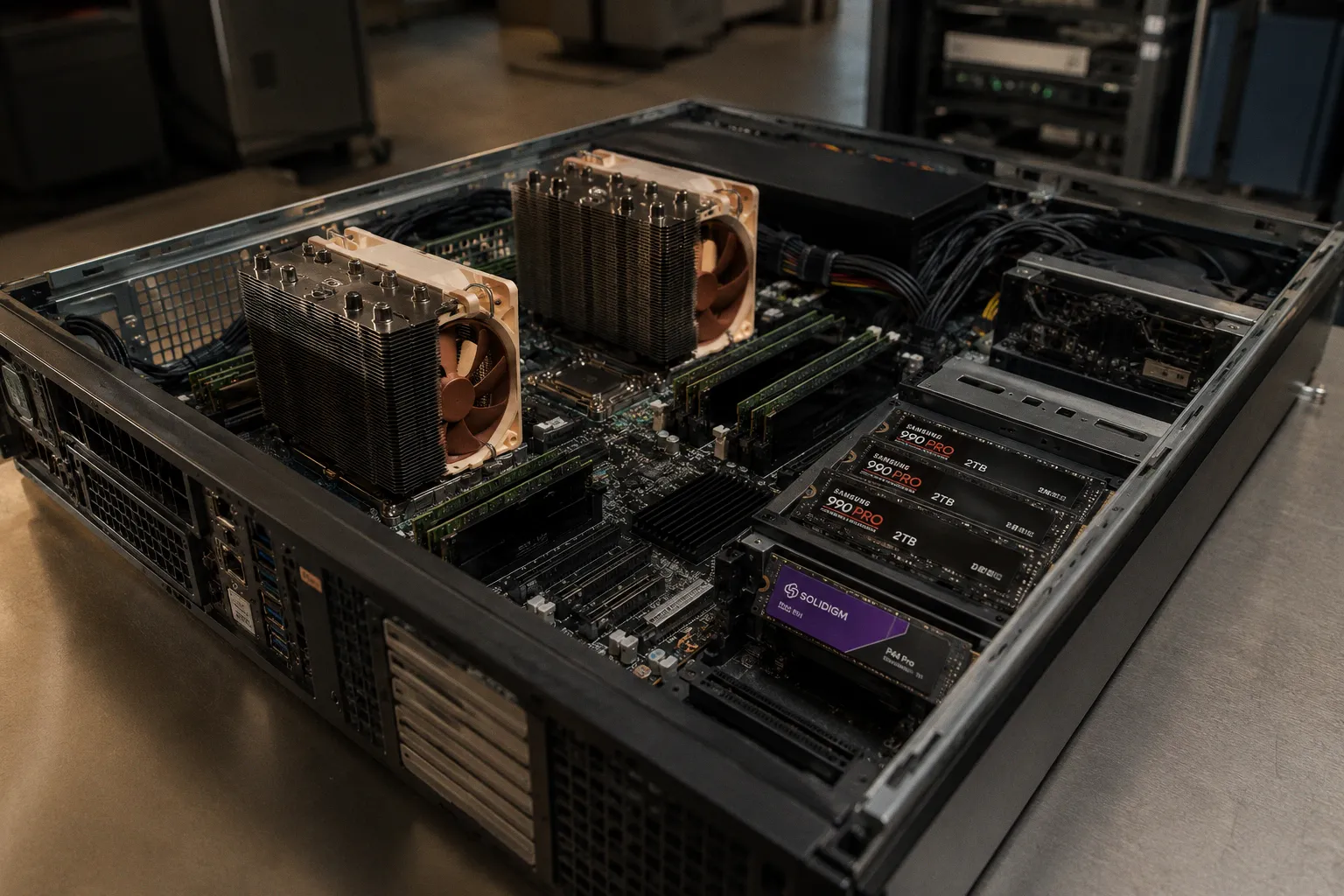
The ledger is the append-only log of all transactions on the network, and its write throughput is the primary I/O bottleneck on a Solana validator. Two distinct NVMe configurations are required: a minimum 1TB NVMe for the operating system and the accounts database, and a separate 2TB or larger NVMe for the ledger. The separation is not optional. Co-locating the ledger and accounts on the same drive creates write contention that manifests as fork selection issues and, eventually, divergence from the cluster.
Standard SATA SSDs are categorically unacceptable. SATA links cap at roughly 600 MB/s, while the ledger write workload can sustain multiple gigabytes per second under peak leader conditions. PCIe Gen3 NVMe drives, while better, are increasingly the constraint point as the network throughput grows; Gen4 NVMe is the effective baseline for a current-generation validator, and Gen5 is the forward-looking investment for operators planning a three- to five-year deployment horizon.
The motherboard must therefore expose sufficient PCIe Gen4 lanes (or higher) to host the accounts drive, the ledger drive, and any additional data drives the operator wishes to attach for snapshots and backups, without falling back to Gen3 or fewer lanes on any of the critical paths.
| Spec Component | Minimum | Recommended (Mainnet) |
|---|---|---|
| CPU Cores / Threads | 12 / 24 | 16+ / 32+ |
| Base Clock | 2.8 GHz | 3.0+ GHz |
| RAM | 256GB | 512GB |
| Accounts DB Drive | 1TB NVMe | 2TB NVMe Gen4 |
| Ledger Drive | 2TB NVMe | 4TB+ NVMe Gen4 |
| PCIe Generation | Gen4 | Gen4 or Gen5 |
| Network Bandwidth | 1 Gbps symmetric | 10 Gbps symmetric |
PCIe Gen4 and Motherboard Integration
PCIe Gen4 doubles the per-lane bandwidth relative to Gen3, and this is the practical floor for hosting NVMe drives at the speeds the validator requires. A motherboard that nominally supports M.2 slots but routes them through a chipset or a Gen3 link introduces a hidden bottleneck that surfaces only under leader schedule pressure. The hardware specs to check before Solana validator setup must therefore include not only the presence of M.2 slots but the PCIe generation and lane allocation for each.
Server-class motherboards in the EPYC and Xeon families typically expose direct CPU-attached Gen4 (or Gen5 on newer platforms) lanes for primary M.2 slots, which is the correct topology. Consumer-grade boards frequently bifurcate lanes across multiple M.2 slots in ways that disable some ports when others are populated, or they route through the chipset at Gen3 speeds. The first symptom of a PCIe topology problem is not an error message; it is a validator that keeps up under steady state but falls behind during its own leader windows, particularly when the accounts database is being compacted. Diagnosing this after deployment is significantly more expensive than verifying the topology during procurement.
Network Infrastructure: 1 Gbps Symmetric, Unmetered
Solana's vote propagation and block dissemination model is highly sensitive to network latency and bandwidth symmetry. A minimum of 1 Gbps symmetric bandwidth is required, and the connection must be unmetered — any provider that imposes traffic caps will produce an outage at the moment a validator is most economically active, namely when it is producing blocks and absorbing transaction fees.
Symmetry matters because outbound (vote and block propagation) and inbound (transaction ingestion) traffic are roughly balanced during leader windows. An asymmetric link, such as a residential cable connection with high downstream and low upstream, starves the outbound path and causes the validator to be perceived as slow by its peers. The downstream-only-bandwidth misconception is one of the more common procurement errors when operators new to infrastructure evaluate the five hardware specs to check before Solana validator setup, and it is rarely caught until the first leader window produces a measurable divergence from the cluster.
Beyond raw bandwidth, jitter and packet loss dominate the effective quality of the connection. A clean 1 Gbps fiber line outperforms a contended 10 Gbps shared line, and operators should colocate with a known exchange or validator-friendly data center rather than provisioning the node from an office or residential address. Public endpoints and residential ISPs introduce variability that the consensus protocol does not account for, and the cost of that variability is paid in missed vote credits.
Closing the Loop: Operational Implications
The five hardware specs to check before Solana validator setup form a coupled system: a CPU shortfall amplifies RAM pressure, an undersized NVMe array overwhelms the PCIe topology, and a constrained network link produces the symptom set that looks like compute failure. Operators who treat any of these specs in isolation end up debugging the interaction effects, often during long sync windows where the only available action is to read and wait. The initial ledger download can stretch from twelve hours to several days depending on disk throughput and RAM, and the downtime is a familiar operational reality; many operators use the window to stay current with broader context beyond the terminal, tracking news and practical life advice while the node catches up to the tip.
The long-term implication is structural. As the network throughput target continues to rise — driven by fee market maturation, increased application activity, and the introduction of new state-intensive primitives — the floor on these specifications rises with it. Validators provisioned to today's minimum will, within a predictable horizon, find themselves at the participation threshold rather than the recommended operating point. The market signal is already visible: stake concentrates on operators who maintain hardware headroom, and slashing risk correlates inversely with infrastructure investment. Regulatory frameworks, as they take shape around proof-of-stake infrastructure, are also likely to treat hardware diligence as a component of operational competence rather than a discretionary optimization, particularly for custodians and staking-as-a-service providers who hold delegated capital on behalf of third parties.
For operators preparing the procurement, the five hardware specs to check before Solana validator setup are not a compliance exercise. They are the substrate on which the rest of the operational practice is built, and the decision made in the procurement phase determines the validator's behavior for the next several years.
In Solana validation, the difference between a reliable node and a chronically underperforming one is almost always a hardware decision made before the first transaction was ever processed.