Galaxy Digital added to Russell 1000 Index, marking a milestone for digital asset firms
Galaxy Digital entered the Russell 1000 after its market cap exceeded roughly $11.55 billion at the April 30 rank date, according to Crypto Briefing.
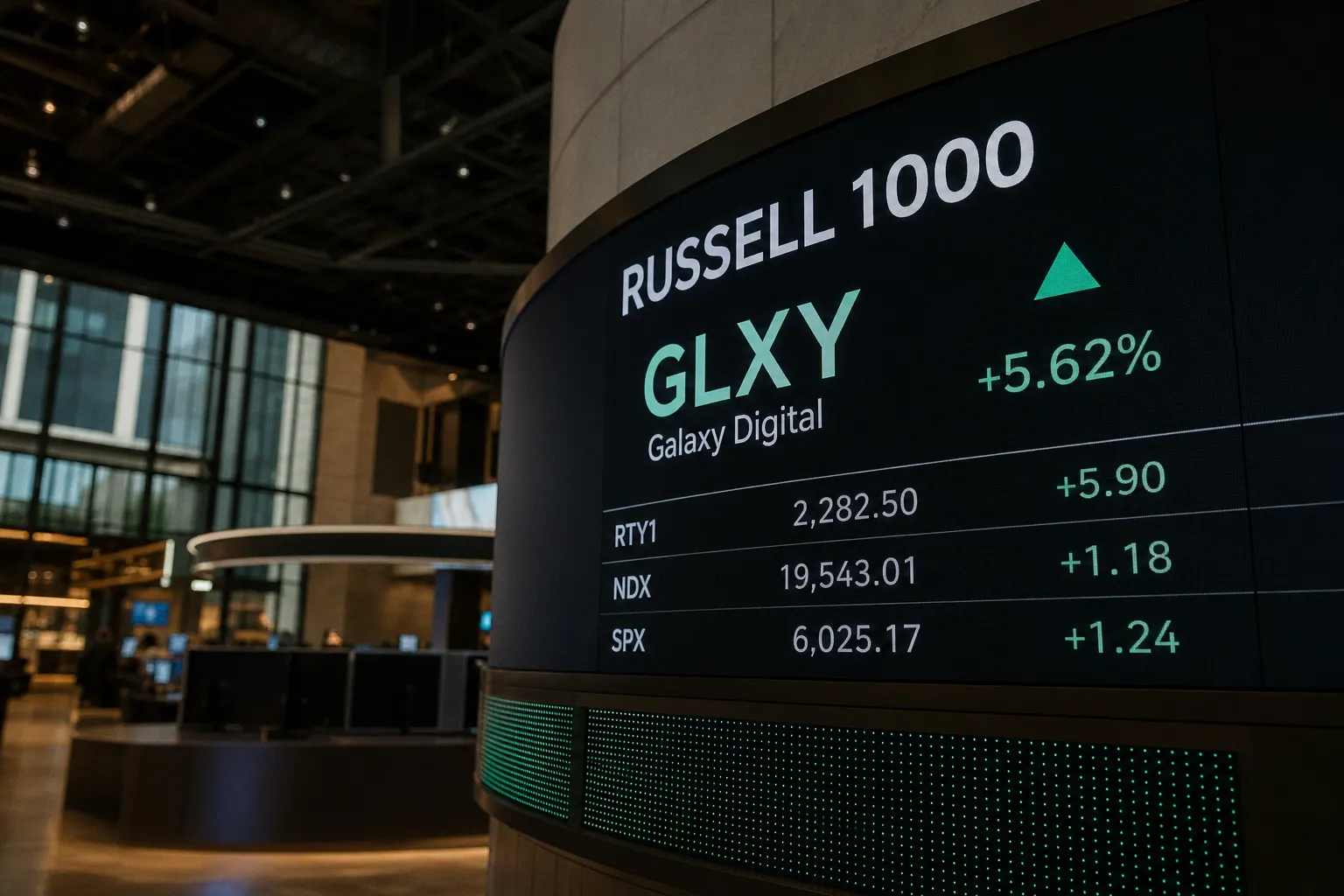
Index inclusion turns Galaxy into a benchmark exposure
The Russell 1000 tracks the 1,000 largest publicly traded companies in the U.S. within the broader Russell 3000 universe. Galaxy was one of 62 companies added in this reconstitution cycle.
The mechanical part matters. Funds and ETFs that track the Russell 1000 need to align with the index. That can create demand that is not based on a fresh view of crypto beta, earnings quality, or balance-sheet risk. It is index plumbing.
Key confirmed data points:
- Galaxy’s market cap exceeded about $11.55 billion as of the April 30 rank date.
- The reconstitution took effect after the market close on June 26.
- Trading under the new Russell 1000 membership began June 29.
- The company had previously completed a Nasdaq listing.
- Galaxy moved from smaller-cap index territory into a large-cap benchmark.
For portfolio managers, the change is practical. Galaxy now appears in large-cap screens. For compliance teams constrained by benchmark eligibility, the index inclusion can reduce one access hurdle. It does not remove volatility risk.
The business is still a crypto-linked operating bet
Galaxy is not a passive proxy. The firm spans institutional trading, asset management, custody, and digital infrastructure. That makes the Russell 1000 inclusion a cleaner public-market access point for digital assets, but not a clean factor exposure.
The operating mix creates two different risk buckets.
First: market sensitivity. Galaxy’s business remains tied to the health of digital asset markets. That linkage matters in drawdowns. Trading activity, asset management flows, custody economics, and institutional demand can all move with crypto liquidity conditions.
Second: infrastructure capex. Crypto Briefing notes Galaxy’s Helios AI compute campus in Texas has approvals for more than 1.6 GW of capacity. That puts the company near two capital-intensive sectors at once: crypto mining infrastructure and AI compute. The opportunity is large, but so is the balance-sheet burden if utilization, financing, or power economics disappoint.
Galaxy has also launched OTC prediction markets trading, adding another institutional product line. That broadens the platform. It also adds another place where revenue quality should be separated from headline expansion.
What to watch after the reconstitution flow
The near-term trade is not the same as the long-term thesis. Index inclusion can generate mechanical buying. Once that flow clears, the stock still has to trade on liquidity, earnings drivers, crypto market conditions, and infrastructure execution.
For investors tracking the name, the checklist is narrow:
- Separate index demand from organic institutional demand.
- Watch whether Galaxy’s Russell 1000 status improves shareholder base quality, not just volume.
- Track how much capital the Helios buildout consumes relative to operating cash generation.
- Treat AI compute exposure as infrastructure risk, not a free multiple expansion.
- Monitor whether Galaxy’s trading and asset management lines hold up if digital asset liquidity weakens.
The milestone is real. A crypto-native financial services firm has moved into a large-cap U.S. equity benchmark. But the risk profile did not become large-cap conservative overnight.
Verdict: Russell 1000 inclusion improves access and may deepen passive ownership. It does not neutralize Galaxy’s core exposure to crypto-cycle drawdowns or the capital intensity of its infrastructure strategy.