Revoke smart contract approvals using Revoke.cash
Every DeFi interaction starts with a token approval. The user clicks "approve" on a DEX, a lending market, or a yield farm, and the contract receives permission to move a specific amount of a token from the wallet.
# How to Manage and Revoke Smart Contract Approvals on EVM Networks
The Hidden Risk of Unlimited Token Approvals
That number is not a metaphor. It is the literal upper boundary of a 256-bit unsigned integer.
The purpose is gas optimization. Approving once means the user does not pay approval gas for every swap, deposit, or borrow. The contract can pull tokens without an extra signature each time. A retail user interacting with a single DEX saves a few dollars a month in repeated approval transactions. For a protocol serving thousands of daily users, the aggregate savings are significant — fewer failed transactions, lower support load, smoother UX. The design decision is rational from the protocol's standpoint. From the user's standpoint, it shifts risk downstream without making that shift visible.
The trade-off is structural. If the contract is exploited, if its admin keys are compromised, or if the deployer turns malicious, that open-ended approval becomes a direct drain on the wallet. The drain is not hypothetical. Phishing sites routinely forge approve() calls that grant attackers the same maximum allowance. In Q1 2024 alone, approval-phishing drainers siphoned over $70 million across EVM chains, according to on-chain analysts tracking Scam Sniffer and related datasets. The attack vector is low-skill: a cloned front-end, a spoofed domain, and a single signed transaction. Once signed, the attacker can move the balance whenever the contract is called and the wallet holds that token.
The timing of the exploit is irrelevant to the approval's lifespan. A user who approved a yield farm in 2021 and never interacted with it again still carries that open allowance today. If the farm's contract was upgraded, its keys were rotated, or its deployer wallet was compromised in the interim, the dormant approval activates as a live drain vector. Stale approvals are not dead permissions. They are sleeping liabilities.
In DeFi, an unlimited approval is not a convenience setting. It is a permanent withdrawal slip left at the counter.
Revoke.cash exists to address this attack surface. It is not a wallet, not a custody solution, and not a fund recovery tool. It is a permission registry for EVM addresses: a read-only layer for inspecting active allowances, paired with the ability to cancel them on-chain through a revocation transaction. The tool has been operational since 2020 and is open-source, with its codebase publicly auditable on GitHub.
Auditing Your Wallet Permissions Across 80+ EVM Networks
The platform supports over 80 EVM-compatible networks. Ethereum mainnet, Polygon, Arbitrum, Optimism, Base, BNB Chain, Avalanche, zkSync Era, Linea, Scroll, and the long tail of L2s and sidechains are all indexed. For an analyst running capital across multiple chains, this coverage matters. Permissions are not centralized by network. An approval granted on a stale Polygon dApp from 2022 remains live until explicitly revoked, regardless of current activity on the protocol.
Cross-chain fragmentation is the core problem Revoke.cash solves at the audit layer. A wallet active across five networks does not have one permission surface — it has five independent surfaces, each with its own allowance history, its own set of approved spenders, and its own gas economics for cleanup. Without a consolidated view, users either ignore the problem or manually check individual block explorers, which is tedious and error-prone.
The audit flow is direct:
1. Connect a wallet via WalletConnect or a direct browser integration. Supported interfaces include MetaMask, Rabby, Coinbase Wallet, Rainbow, and most EIP-1193 providers. No seed phrase is ever shared with the platform.
2. The tool pulls all ERC-20 allowances tied to the address across every supported chain. This is a read query — no gas, no signature prompt. The data is sourced from on-chain storage slots.
3. The interface outputs a list of approvals, with each entry showing token symbol, approved spender, allowance amount, the underlying chain, and a risk assessment where available.
4. Entries flagged as "Unlimited" or matching a known malicious contract registry are surfaced first. The platform integrates data from community-maintained threat lists and block explorer verification statuses.
The output is a permission ledger. Each row is a live vector. From a risk standpoint, the ledger answers two questions: who can move funds, and how much.
The answer frequently surprises users. Most wallets carry 5 to 30 active allowances at any given time, accumulated from one-off DeFi interactions. Each one is a latent exposure. Address history compounds the problem — a user active for two years across farming cycles typically holds dozens of stale approvals, many of them unlimited, many targeting contracts that have since been deprecated, abandoned, or exploited.
The audit is also the first step in any post-incident triage. If a user suspects a phishing interaction or observes an unexpected token outflow, checking the approval ledger reveals whether the drain path was a compromised allowance or a different exploit vector entirely. This diagnostic function is underappreciated — it tells the user whether revocation is relevant or whether the compromise happened at a different layer (seed phrase leak, wallet drainer, malicious signing).
Step-by-Step Guide to Revoking Malicious or Unused Allowances
Revocation is the active countermeasure. The process is identical across networks: submit an approve() call setting the allowance to zero for the target spender. Gas is paid in the native asset of the chain on which the approval was originally granted.
The execution path on Revoke.cash:
1. Identify the entry to revoke. Prioritize unlimited approvals to contracts no longer in use, approvals to unknown or unverified spenders, and any approval tied to a project that has been exploited, rugged, or deprecated. Use the platform's sorting and filtering to surface these first.
2. Select the network. The platform lists the chain where the approval was originally granted. Revocation must occur on the same network. An approval on Arbitrum cannot be revoked from mainnet — they are independent ledgers.
3. Sign the revocation transaction. The platform reissues approve(spender, 0). The user signs with the same wallet that holds the allowance. The transaction calldata is minimal — it contains only the spender address and the zero value.
4. Pay network gas. Revoke.cash charges zero platform fees. The cost is purely the network gas rate, denominated in ETH, MATIC, BNB, or the relevant native asset. The platform estimates gas before confirmation so the user can evaluate cost against exposure.
A confirmed revocation zeros out the allowance. The contract can no longer pull tokens. Future approvals require a fresh signature from the wallet holder. The revocation is irreversible in effect — the allowance is gone, and a new interaction with the same protocol will require a new approve() transaction.
For users managing multiple stale approvals, the platform supports batch revocation. Select multiple entries, confirm each transaction sequentially, and the tool queues them in order. This is materially faster than revoking one-by-one through a block explorer.
Common execution errors to avoid:
- Revoking on the wrong chain. A spender approved on Arbitrum is unaffected by a revocation submitted on mainnet. Double-check the chain indicator before signing.
- Revoking during congestion. Gas spikes on mainnet can push the cost of a single revocation above the value of the underlying position. Batch revocations during low-activity windows — typically weekends or early UTC hours — for cost efficiency.
- Treating revocation as history removal. On-chain history is permanent. Revocation only kills the permission, not the trail. Anyone can still see that the approval once existed by reading historical transaction logs.
- Forgetting ERC-721 and ERC-1155 approvals. Revoke.cash covers these as well. NFT approvals are a separate and often overlooked drain vector — setApprovalForAll grants the spender access to the entire collection, not a single token.
Integrating Hardware Wallets and Browser Extensions for Proactive Security
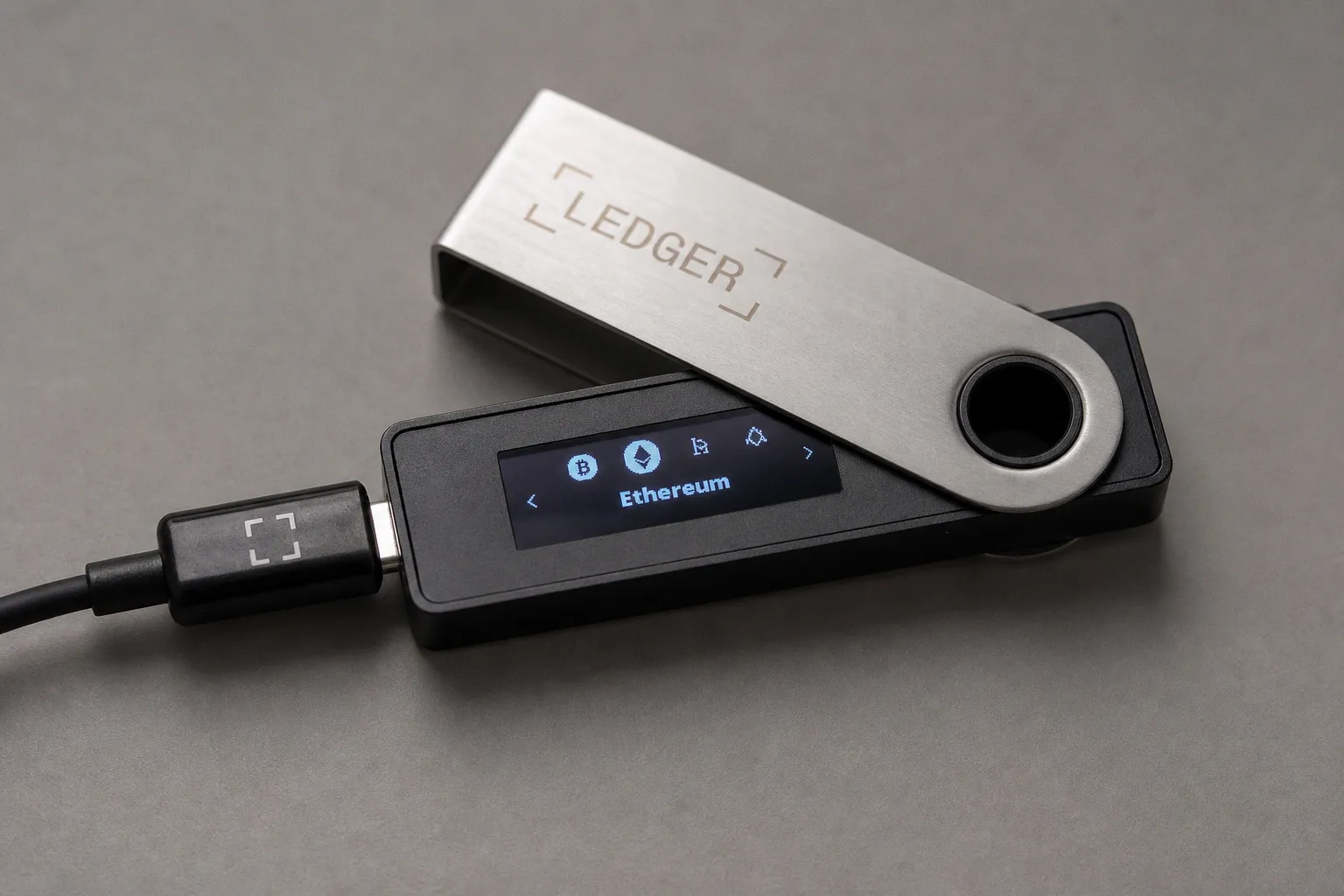
For capital held on Ledger, Trezor, or other hardware wallets, Revoke.cash supports direct connection. Private keys remain on the device. The platform reads allowances using view functions and signs revocations through the hardware signing pipeline. The user physically confirms each revocation on the device screen — the same security model as any standard transaction.
This is the preferred configuration for any allocation above dust size. Cold storage delivers isolation only if the permission surface is also cold. An approved allowance on a hardware-secured wallet is the same exposure as an approved allowance on a hot wallet — the attacker controls the inbound path, not the storage device. A Ledger holding $100,000 in stablecoins with an unlimited approval to a compromised DeFi contract is not cold storage in any meaningful sense. It is cold key management with a hot drain valve.
The browser extension closes the loop on the front end. Available for Chrome, Firefox, and Brave, it intercepts approve() calls in the transaction simulation layer before they hit the wallet confirmation screen. High-risk or unlimited approvals trigger a warning pop-up showing the spender address, the allowance type (limited vs. unlimited), and an option to proceed or modify the approval amount before signing.
The extension does not block transactions. It surfaces risk. Sign-off remains with the user. This is a critical design choice — a blocking extension would introduce a single point of failure and create friction that users would disable. The warning model respects user autonomy while adding a friction layer precisely where the risk concentrates.
A layered configuration for an institutional-grade setup:
| Layer | Tool | Function |
|---|---|---|
| Asset storage | Hardware wallet (Ledger / Trezor) | Private key isolation; physical confirmation |
| Permission audit | Revoke.cash (web app) | Cross-chain allowance inspection |
| Permission cancellation | Revoke.cash (web app) | On-chain revocation via zero-approval |
| Transaction screening | Revoke.cash (browser extension) | Pre-sign approval warnings |
| Ongoing monitoring | Scheduled manual audits or alert integrations | Quarterly or monthly review cycle |
Each layer addresses a distinct failure mode. Storage without permission hygiene is incomplete coverage. Audit without revocation is surveillance without response. Screening without periodic full audits misses approvals granted before the extension was installed. The stack works as a system, not as isolated tools.
For teams and treasuries managing multi-sig wallets (Gnosis Safe, Safe{Wallet}), the same audit principles apply. Multi-sig approvals are visible through Revoke.cash the same way EOA approvals are, though revocation requires the standard multi-sig confirmation threshold. This adds latency but does not change the security model.
Understanding the Financial Reality of Revocation Transactions
Revocation is not free. Every cancellation is an on-chain action that consumes gas. On Ethereum mainnet during average conditions, a single ERC-20 approve() costs between $2 and $15 depending on the token contract's verification status and current gas prices. Verified contracts with deployed source on Etherscan are cheaper to validate at the EVM level. On L2s and sidechains, the cost drops below $0.50 in most periods — often below $0.10 on Arbitrum, Base, and Optimism during low-activity windows.
The economics shift by chain:
- Ethereum mainnet: Revoke when allowances accumulate against contracts that no longer justify the exposure. A $10 gas fee on a wallet holding $50,000 in stablecoin approvals to a deprecated farm is rational spend. A $10 gas fee to revoke a $2 approval to a functioning protocol is not — weigh the cost against the realistic exposure.
- L2s (Arbitrum, Optimism, Base, zkSync): Revoke liberally. Gas is negligible. The cost-benefit ratio favors routine cleanup even for small approvals.
- Sidechains (Polygon, BNB Chain, Avalanche C-Chain): Same logic as L2s. Revoke at the next opportunity without agonizing over the gas cost. Sub-dollar revocations are the norm.
What revocation does not do:
- It does not reverse completed transactions. Stolen funds cannot be recovered through this tool — once a malicious spend() call executes, the funds are gone. Revocation is prospective, not retroactive.
- It does not protect against all smart contract exploits. A contract can still drain funds through logic flaws, oracle manipulation, reentrancy bugs, or flash loan attacks, even with zero allowance standing at the time of the incident. Approval revocation addresses only the approve()-based attack vector.
- It does not replace wallet-level security. Seed phrase hygiene, phishing awareness, domain verification, and transaction simulation remain primary controls. Approval management is a secondary layer that reduces blast radius.
- It does not cover permit-based approvals (EIP-2612). Some protocols use gasless permit signatures instead of on-chain approve() calls. These are stored off-chain until executed and are not always visible in standard allowance queries. Revoke.cash has been expanding coverage of permit-based risks, but users should be aware that not all approval vectors appear in the same ledger.
Revocation is maintenance, not insurance. It reduces the attack surface. It does not eliminate it.
Verdict on Revoke.cash as a Security Layer
For any active DeFi user, the tool is non-optional. The combination of 80+ network coverage, hardware wallet integration, and a browser extension for pre-sign screening creates a complete permission-management loop. There is no comparable on-chain alternative that consolidates this surface across the EVM ecosystem with the same depth and zero fee model.
The platform charges zero fees. Gas is the only cost, and gas is the cost of every on-chain action. In a yield-sustainability frame: the tool has zero yield, zero ROI, and zero liquidity drawdown. It is pure expense. The return is the avoided drawdown from a compromised approval — an asymmetric bet where the downside of inaction is total loss of an approved token balance, and the cost of action is a few dollars in gas.
From an on-chain perspective, the operational cadence is clear:
- Every active wallet should be audited at least quarterly.
- Every unlimited approval to a defunct protocol should be revoked immediately.
- Every approval granted to a fresh, unaudited contract should be revoked at the end of the interaction session if the user does not plan to return.
- High-frequency DeFi users running multiple chains benefit from a monthly audit cycle at minimum.
- Any wallet involved in a suspected phishing incident should be audited within minutes, not hours — attackers monitor pending approvals and execute drain transactions as soon as the victim's balance is replenished.
Broader security hygiene extends beyond approval management. Analysts tracking exploit patterns, narrative cycles, and emerging threat vectors benefit from monitoring on-chain data directly through block explorers, protocol documentation, and allowance registers — the same infrastructure that powers tools like Revoke.cash. For permission management specifically, the actionable data lives in the chain state. The toolset to read and act on that data exists, is free, and is battle-tested. The discipline behind using it is the variable that separates protected wallets from exposed ones.