Run an Ethereum validator node on Raspberry Pi 5
The Raspberry Pi 5 has matured into a legitimate candidate for hobbyist Ethereum staking, but the path from unboxing to attestation involves architectural decisions that diverge sharply from a conventional x86 mini-PC setup.
Lead
The gap between "it boots" and "it attests reliably for twelve months without intervention" is where most hobbyist deployments quietly fail. Closing that gap requires understanding the Pi 5 not as a cheap Linux box, but as a constrained embedded platform being asked to do something it was never designed for — and doing it well enough, if you respect the constraints.
Hardware Architecture and Performance Constraints
The Pi 5 ships with a Broadcom BCM2712 SoC featuring a quad-core Arm Cortex-A76 processor clocked at 2.4 GHz, a substantial uplift over the Cortex-A72 in the Pi 4 but still a mobile-derived core without the out-of-order aggressiveness of server-class silicon. The memory subsystem — LPDDR4X-4267 in either 4GB or 8GB configurations — is shared across CPU, GPU, and I/O, which means the effective memory bandwidth available to validator processes under load is lower than the spec sheet implies.
For Ethereum validator workloads, this manifests in two practical constraints. First, the execution client (Geth, Nethermind, Besu, Erigon) must maintain and continuously update the EVM state trie — a workload that scales with chain growth and stresses both single-threaded performance and memory bandwidth. State trie operations involve random-access reads and writes across a dataset that currently exceeds 100GB and grows by several gigabytes per quarter. Second, the consensus client (Lighthouse, Prysm, Teku, Nimbus) must process attestations, aggregate signatures, and gossip blocks across the libp2p network in real time. Both clients share the same SoC, the same memory subsystem, and the same thermal envelope.
The result is a workload profile where CPU contention between the two processes translates directly into missed attestations, which erode validator rewards and, in sustained cases, trigger inactivity leak penalties. A single missed attestation costs a fraction of a cent in ETH terms at current rates, but the compounding effect of systematic misses — say, 2–5% of attestations dropped due to throttling or memory pressure — erodes staking yield noticeably over months. This is the architectural reality that defines every downstream decision in the setup.
Essential Storage and Connectivity Requirements
A microSD card will not survive a month of Ethereum validator operation; the chain state will outgrow it and the IOPS profile will destroy it long before then.
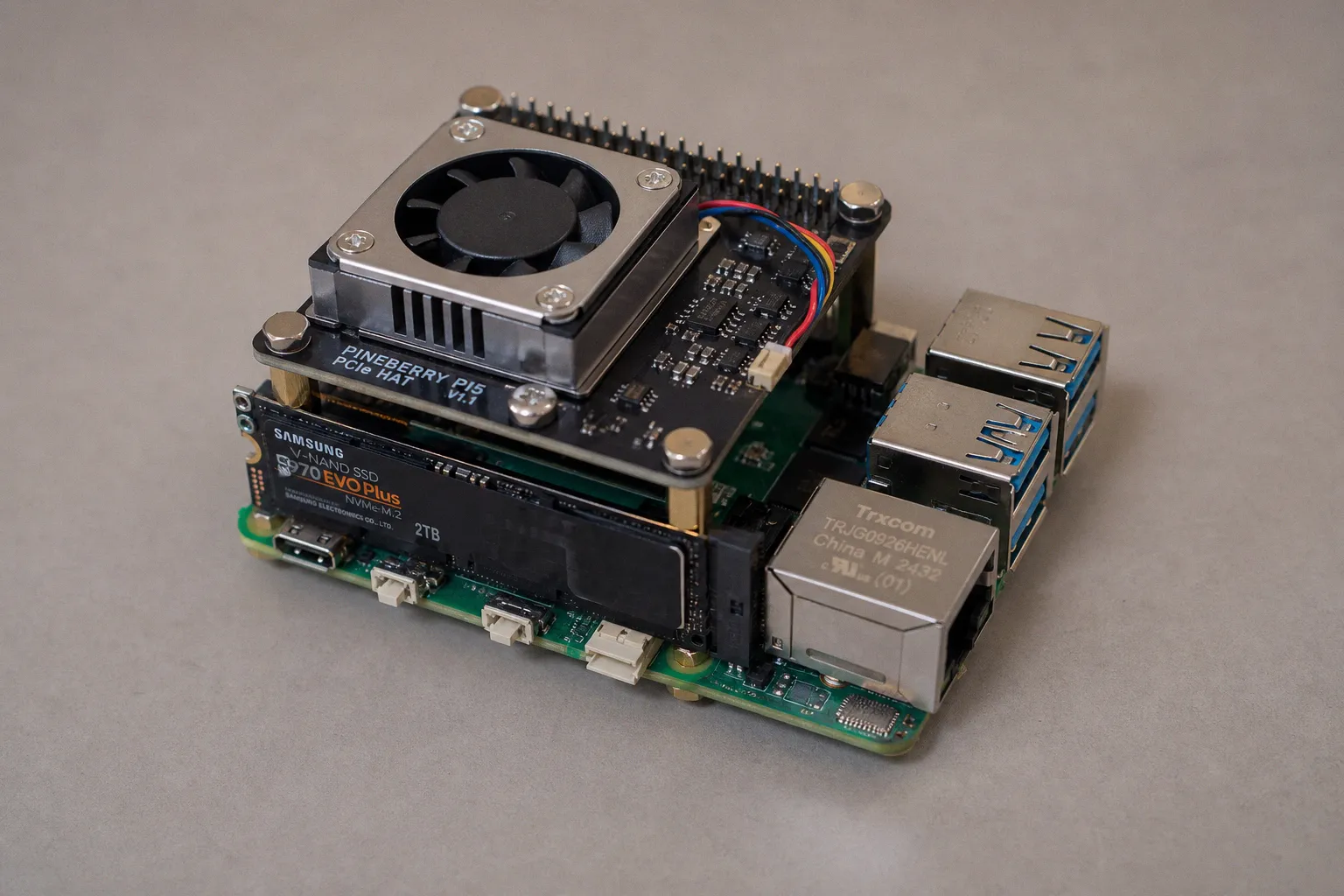
For storage, the Pi 5 introduces a key capability: a PCIe 2.0 x1 interface exposed via the FPC connector on the board, which — combined with the official M.2 HAT+ or a compatible third-party base — enables direct connection of an NVMe SSD. This is non-negotiable for validator stability. The chain database for an Ethereum full node grows continuously and demands high IOPS for state lookups, block processing, and historical queries. A high-endurance NVMe SSD with at least 2TB of capacity is the floor, given state bloat trajectories over a multi-year staking horizon. Drives marketed for client workloads — WD Red SN700, Samsung 990 Pro, or similar — with published endurance ratings above 600 TBW provide the margin of safety that consumer QLC drives do not.
| Storage Medium | Random Read IOPS (approx.) | Endurance (TBW) | Validator Viability |
|---|---|---|---|
| MicroSD (UHS-I) | 1,000–3,000 | ~10–100 TBW | Not viable; fails within weeks |
| SATA SSD (via USB 3.0) | 20,000–50,000 | 150–600 TBW | Marginal; USB overhead limits IOPS |
| NVMe SSD (PCIe Gen3 via HAT) | 200,000–500,000 | 300–1,200 TBW | Recommended for sustained operation |
The PCIe 2.0 x1 lane on the Pi 5 caps sequential throughput at roughly 500 MB/s — well below what a Gen3 NVMe drive is capable of on a desktop board — but validator workloads are overwhelmingly random I/O bound, not sequential. The NVMe controller's ability to handle deep command queues matters more than peak sequential throughput, which is precisely why NVMe remains superior to USB-attached SATA even at PCIe 2.0 bandwidth.
On connectivity, the Pi 5's Gigabit Ethernet provides sufficient bandwidth for block propagation and peer discovery. However, the validator's network uptime must approach 100%; even short disconnections produce missed attestations, and prolonged downtime triggers the chain's inactivity leak, which escalates quadratically. A wired connection with a documented failover path — a secondary mobile hotspot or a second uplink — is prudent for hobbyist deployments where household network interruptions are a reality. Port forwarding or NAT traversal for the consensus client's libp2p port (default 9000/TCP and 9000/UDP) ensures the node maintains a healthy peer count and is not reliant on bootnodes for connectivity.
Selecting and Configuring Ethereum Clients for ARM64
The Ethereum validator architecture is a two-client system: a consensus client handles the proof-of-stake duties — attestations, block proposals, fork-choice — while an execution client maintains the EVM state and the JSON-RPC surface. The two communicate via the Engine API, a local authenticated IPC channel that must be firewalled against external access.
ARM64 compatibility is mature but uneven across the client ecosystem. Lighthouse (consensus) paired with Geth (execution) is the most widely tested combination on ARM64 hardware and has the longest community track record. Prysm, Teku, and Nethermind all support ARM64 but with varying degrees of optimization; Nimbus, written in Nim, has historically performed well on resource-constrained ARM devices due to a smaller memory footprint and a less aggressive garbage collection cycle. The choice affects memory consumption, startup time, and resilience under memory pressure — all of which matter more on a Pi 5 than on a machine with 32GB of headroom.
Memory is the second critical constraint. While the Pi 5 ships in 4GB and 8GB variants, 8GB is the operational minimum for a combined client setup, and configurations pushing toward 16GB are preferable as chain state grows — a configuration the Pi 5 does not yet offer, which is one of its genuine limitations for long-haul staking. Under-provisioned memory forces swap activity, which on NVMe is survivable but accelerates flash wear and adds latency spikes during attestation duties. A pragmatic configuration uses a compressed zram swap device to absorb memory spikes without hitting the SSD, combined with explicit memory limits set via systemd or client configuration flags to prevent any single process from consuming the entire system RAM.
RPC exposure requires deliberate configuration: binding the JSON-RPC port to localhost and fronting any remote access with a reverse proxy and authentication is the standard posture, given the well-documented attack vectors against publicly exposed Ethereum nodes. Open RPC endpoints have been exploited for transaction injection, MEV extraction, and denial-of-service against node operators — this is not theoretical. Restricting Engine API access to localhost is equally important, as a compromised Engine API endpoint can trigger fork-choice manipulation or forced invalid block proposals.
Thermal Management and Power Delivery
A Pi 5 under sustained validator load draws 8–12 watts and dissipates that heat across a small PCB footprint. The official Active Cooler, or a comparable third-party heatsink-and-fan assembly, is not optional. Without active cooling, the SoC will throttle within minutes under full multi-core load, and validator attestation timing is unforgiving of throttled cores — a missed attestation is an immediate reward reduction. The Cortex-A76 cores begin throttling around 80°C, and under a combined execution-plus-consensus workload without a cooler, junction temperatures can exceed that threshold within two to three minutes of sustained operation.
Ambient temperature matters more than most guides acknowledge. A Pi 5 in an enclosed case in a room that reaches 30°C in summer has a fundamentally different thermal margin than the same board on an open bench in a climate-controlled office. Operators in warm climates should factor seasonal temperature variation into their reliability planning — a setup that runs clean in January may produce systematic throttling in July.
Power delivery is the second silent failure mode. The Pi 5 requires a USB-C power supply rated at 5V/5A (25W) for sustained full-load operation. Under-rated supplies — phone chargers, older Pi 4 PSU units, thin USB-C cables with high resistance — will trigger undervoltage warnings and can produce subtle consensus errors during peak gossip traffic. These errors do not always manifest as crashes; they can present as intermittent attestation misses, peer disconnections, or slow state trie operations that silently degrade performance. A quality PSU with adequate cable gauge is cheap insurance against hours of debugging.
Throttling, undervoltage, and IOPS starvation are the three classic failure modes of a Raspberry Pi 5 validator; each silently degrades attestation performance before producing an outright crash.
Operational Risks and Long-term Reliability
Running an Ethereum validator on a Raspberry Pi 5 is an exercise in managing constrained resources against an adversarial network environment. The setup is viable, but it remains hobbyist-grade — not because the Pi 5 is fragile, but because the unknowns around long-term ARM64 stability under 24/7 high-load conditions are genuinely unsettled compared to x86-based mini-PCs that have accumulated years of operational telemetry.
The concrete risks are not abstract. State bloat accumulation means the validator's resource demand grows monotonically over its operational lifetime; a setup comfortable today may find itself marginal in two years as the chain state expands beyond what 8GB of RAM can comfortably cache. Sync times after extended offline periods can stretch to days on a Pi 5, during which the validator accrues inactivity penalties that can take weeks of clean operation to recover. Slashing risk, while low for a single honest operator, is total and unrecoverable: a double-signing event caused by running two instances of the same validator key, or by corrupting the slashing protection database, destroys the entire 32 ETH stake in a single epoch.
Operational discipline matters more than hardware choice. A few non-negotiable practices for any Pi 5 validator deployment:
1. Monitoring and alerting. Prometheus exporters for both clients feed into a Grafana dashboard tracking attestation success rate, peer count, sync status, and system metrics (CPU temperature, memory pressure, SSD health via SMART). Alerting on attestation miss rates above 1% for consecutive epochs gives early warning before penalties accumulate.
2. Slashing protection. Never run the same validator key on two machines simultaneously. Maintain a slashing protection database on reliable storage and back it up. A corrupt or lost slashing protection database is the most common path to an accidental double-sign.
3. Key separation. The validator signing key lives on the node; the withdrawal credentials and seed phrase never touch it. This limits the blast radius of a compromised node to missed attestations, not to the full stake.
4. Automated restarts with backoff. Use systemd watchdog timers or a supervisor process to restart crashed clients with exponential backoff, preventing restart loops from hammering the SSD or the network.
5. Upgrade discipline. Test client upgrades on a non-validator Pi 5 or in a testnet environment before applying to production. A botched upgrade during a consensus change can trigger inactivity penalties or, in the worst case, a slashing event.
For operators who want to verify the operational benchmarks of specific client combinations on ARM64 rather than rely on anecdotal reports, the most reliable approach is to run the target client pair on a dedicated testnet validator for several weeks and measure attestation performance, memory utilization, and thermal behavior under realistic conditions. Community forums and client-specific Discord channels provide raw telemetry from other ARM64 operators, but measured data from your own hardware under your own conditions is always more valuable than generalized benchmarks.
Closing Position
The Raspberry Pi 5 validator is a proof of concept for ARM64 decentralization at the edge — a meaningful experiment in lowering the hardware floor for staking participation, even as it remains below the bar of professional-grade infrastructure. The platform is capable, the engineering is achievable, and the community knowledge base is deep enough to debug the common failure modes. What it is not, at least not yet, is a turnkey appliance.
The long-term implications are positive for network decentralization if ARM64 client support continues to mature and if the open questions around sustained-load stability are answered by the community over the coming years. The Raspberry Pi 5 offers a sub-$100 entry point for the board alone — factoring in NVMe storage, cooling, and a proper PSU brings the total to roughly $200–300, which is a fraction of the cost of even a budget x86 mini-PC. That cost differential is the real argument for ARM64 staking: not performance parity, but accessibility. More operators running on cheaper, more diverse hardware makes the network harder to coerce and harder to censor. Until the platform matures further, operators should treat the setup as a learning environment first and a yield-generating asset second — and build the operational discipline on the Pi that they will eventually need on whatever hardware they scale to next.