Altcoin mining hardware: ASIC vs GPU differences
The first hard truth in altcoin mining hardware is that “more hashrate” is not a buying thesis. A number on a product page only makes sense inside its own algorithm, electrical setup, and network conditions.
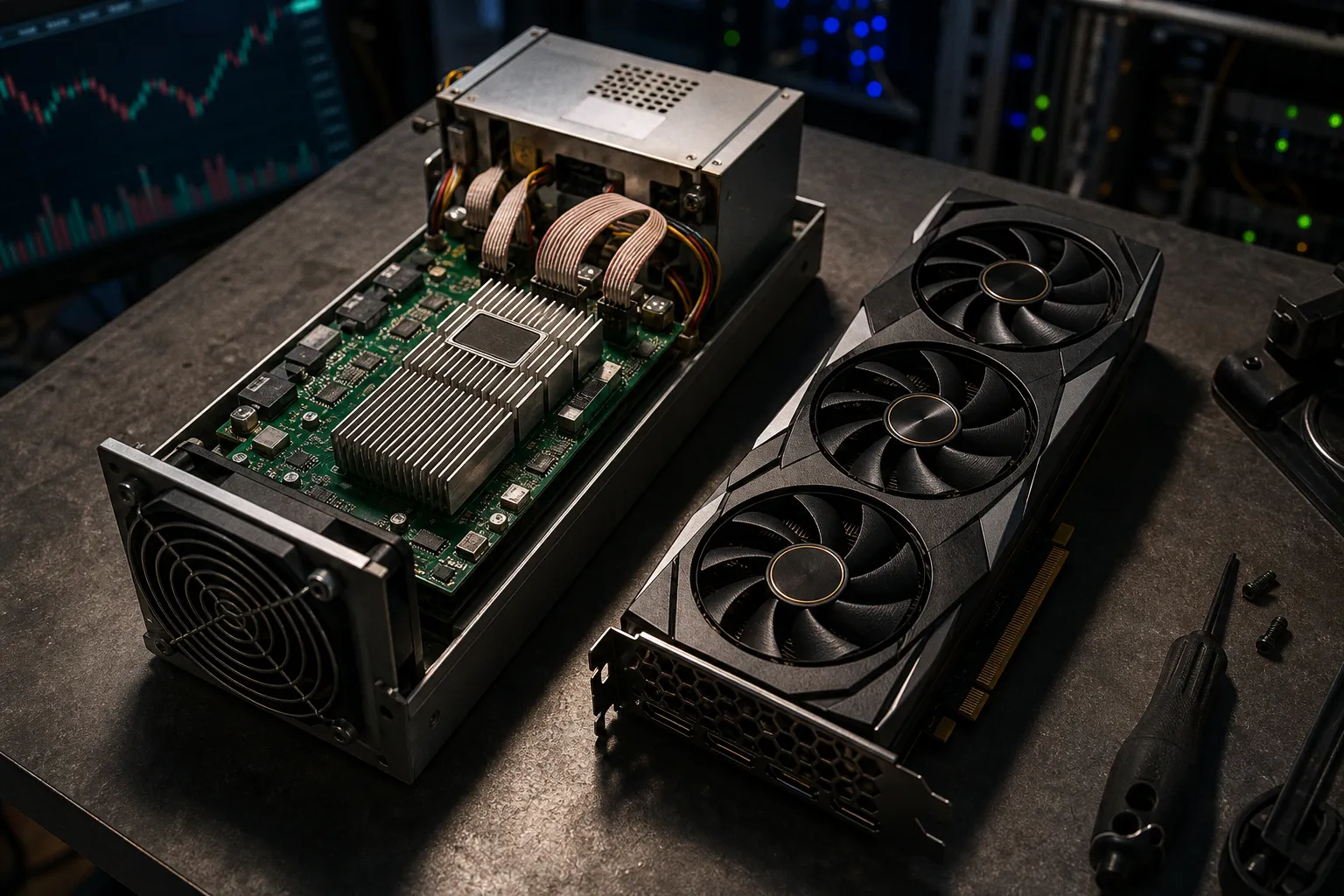
A 16 GH/s Scrypt ASIC and a GPU reporting a rate on another algorithm are not competing on one universal scoreboard.
That distinction gets missed because the old GPU-mining story was simple: build a rig, point it at a coin, tune it, and move if the economics change. ASIC mining offers a different bargain. It trades flexibility for specialization, and often turns a home hobby into a small infrastructure operation faster than newcomers expect.
For communities choosing between GPU vs ASIC altcoin mining, this is not merely a hardware preference. It shapes who can participate, how quickly a network concentrates around industrial operators, and whether a miner has an exit when an algorithm’s incentives shift.
The core divide: fixed-function ASICs versus programmable GPUs
An ASIC — application-specific integrated circuit — is built for a defined function. In mining, that normally means a defined hashing algorithm or algorithm family. Its circuitry is not there to explore other workloads, run a game, render a video, or pivot elegantly to a new proof-of-work network. It is there to produce hashes efficiently for its intended target.
A GPU is a programmable parallel-computing device. That is the practical reason GPU rigs remain relevant even when they lose a direct efficiency contest against a mature ASIC market. The owner can change mining software, alter settings, test a supported algorithm, or stop mining entirely and repurpose the hardware for other compute tasks.
| Parameter | ASIC miner | GPU mining rig |
|---|---|---|
| Core design | Fixed-function hardware for a specific task or algorithm | Programmable parallel processor running different software workloads |
| Algorithm flexibility | Narrow; tied to supported algorithm(s) | Broad relative to ASICs; depends on GPU support and miner software |
| Efficiency on a mature target | Often highly optimized for its target algorithm | Usually less efficient when competing against purpose-built ASICs |
| Repurposing options | Limited if mining economics deteriorate | Can move between supported workloads and non-mining uses |
| Deployment style | Often closer to appliance or facility hardware | Modular, component-based, and easier to modify incrementally |
| Community effect | Can reward scale, sourcing, and power access | Can preserve lower-barrier participation for longer, though not permanently |
Bitmain’s ANTMINER L9 illustrates the ASIC side cleanly. The 16 GH/s version is specified for Scrypt and lists coins including Litecoin and Dogecoin among its supported targets. That is not a general-purpose machine that happens to mine. It is a purpose-built Scrypt appliance.
A GPU rig, by contrast, is an adaptable collection of components. Its actual output depends on the precise card, memory configuration, drivers, miner version, power limit, cooling, and the algorithm being run. That flexibility is useful, but it also means there is no honest universal GPU hashrate figure or “best GPU” answer detached from a specific coin and setup.
ASICs buy efficiency by narrowing your choices. GPUs preserve choices by accepting more operational ambiguity.
The usual framing says ASICs are for professionals and GPUs are for beginners. It is too neat. A GPU rig can be technically demanding to tune, maintain, and cool. An ASIC can be simple to point at a pool, yet completely unforgiving once it arrives in a space with inadequate power, ventilation, or noise isolation.
The meaningful question is not which machine is more advanced. It is which kind of constraint a miner is actually prepared to live with.
The ASIC experience is mostly about power, heat, and noise
A mining machine is not just a machine. It is a continuous electrical load that becomes heat, plus fans trying to move that heat somewhere else. The moment a miner treats it like a desktop peripheral, the user friction starts.
Take the ANTMINER L9’s published figures. The 16 GH/s model has typical wall power of 3,360 watts at 25°C, with a stated typical efficiency of 210 J/GH. Running continuously, 3,360 watts works out to 80.64 kWh every 24 hours before ventilation, cooling, networking, or any other site load enters the picture.
That number changes the conversation. A miner might compare hardware prices and projected pool revenue, then discover that the practical constraint is the building itself.
The L9’s listed electrical requirements are 220–277 V single-phase AC and up to 20 A input current. It uses Ethernet, not a consumer Wi-Fi workflow. Its specified noise level is 75 dBA at 25°C with maximum fan speed. Its operating range reaches 45°C, but a published operating range is not permission to ignore airflow. In a cramped, recirculating room, ambient temperature and hot exhaust will become the real governors.
For an ASIC deployment, the operational questions arrive in a particular order:
1. Can the circuit safely support a continuous load at the required voltage and current? A plug shape or a spare outlet is not an electrical plan. The circuit, wiring, breaker capacity, and local installation standards matter.
2. Where does the heat go? The miner’s electrical draw is effectively heat released into the room. A window, a small fan, and optimism are not equivalent to designed exhaust and fresh-air intake.
3. Who has to live with the sound? Seventy-five dBA is a serious, persistent acoustic presence. It affects housemates, neighbors, shared workspaces, and the likelihood that a “side project” becomes a community dispute.
4. What happens during an outage or thermal event? Mining rigs are meant to run continuously, which makes restart behavior, remote access, pool failover, and temperature monitoring part of the ownership experience.
5. What is the local electricity rate after all-in costs? The wall draw is only the base load. Fans, ventilation, cooling, and sometimes electrical upgrades belong in the calculation.
GPU rigs have their own heat and cable-management risks, of course. But they are more naturally modular. A miner can add a card, cap power, remove a card that runs hot, or distribute capacity across several locations. With a single high-power ASIC, the unit of decision is larger. So is the consequence of getting it wrong.
This is why the best hardware for mining altcoins is often not the one with the most attractive screenshot from a profitability calculator. It is the machine that matches the physical reality of the operator’s site.
“ASIC-resistant” was always a moving target
Mining communities often use “ASIC-resistant” as shorthand for a friendlier, more distributed proof-of-work environment. The instinct is understandable. If ordinary users can run mining software on broadly available GPUs, the barrier to contributing hash power may be lower than in a network dominated by specialized equipment.
But ASIC resistance is not a permanent technical property.
Ethereum’s former Ethash design was memory-hard and was widely understood as an attempt to make ASIC specialization less attractive. ASICs still emerged. The lesson is not that memory-hard algorithms are pointless. It is that a design can raise the cost and complexity of specialization without making specialization impossible forever.
Then Ethereum changed the frame entirely. On September 15, 2022, The Merge replaced proof-of-work mining on Ethereum Mainnet with proof-of-stake validation. There is no Ethereum Mainnet GPU mining path to return to, and there is no Ethereum ASIC purchase that turns into a validator setup.
A validator is staking infrastructure. It secures a proof-of-stake network through staked assets and validator software, not hash power. Ethereum’s solo validator requirement is 32 ETH, but that should not be read as a mining hardware comparison. These are different security models, different capital commitments, and different kinds of participation.
That distinction matters because mining conversations often carry old mental shortcuts into new infrastructure. “I used to mine ETH on GPUs” does not translate into “I can mine ETH again,” and it does not translate into “my rig is now a validator.”
For altcoin communities, the deeper question is governance through incentives. What kind of participant does a mining design invite?
- A GPU-friendly algorithm can make it easier for hobbyists and smaller operators to join early, though electricity costs and tuning skill still create uneven advantages.
- An ASIC-friendly algorithm can deliver impressive specialized efficiency, while making supply chains, hosting contracts, and power procurement more central to network participation.
- Any successful proof-of-work network can attract professional capital. Hardware accessibility may delay concentration or reshape it, but it does not erase economic gravity.
Decentralization is not secured by a slogan about hardware. It is secured by who can realistically acquire, run, and sustain that hardware over time.
That is the part worth following in DAO forums, mining-pool discussions, and ecosystem governance debates. The hardware market does not sit outside the protocol. It helps decide whose voice is operationally present.
Hashrate is not revenue, and efficiency is not a guarantee
Manufacturer specifications are useful inputs. They are not a contract with the future.
Bitmain lists the L9’s typical hashrate with a possible fluctuation of ±3%. Wall power and efficiency can fluctuate by ±5%. Those tolerances are not a minor footnote when margins are thin. They mean a machine should be evaluated as a range of possible field performance, not as a perfectly fixed 16 GH/s and 3,360 W outcome.
The same caution applies even more strongly to profitability estimates. Mining calculators necessarily use a snapshot of network difficulty, block rewards, coin pricing, pool settings, and electricity cost assumptions. The resulting figure is a reference point, not a promise.
A usable profitability model has to account for several moving parts:
- Network difficulty and total hashrate: If more machines come online, each unit of hashrate may earn less of the available reward.
- Coin price: Revenue denominated in a coin can look stable while its fiat value moves sharply.
- Pool fees and payout structure: A pool’s method of distributing rewards affects variance and net proceeds.
- Electricity rate: This is often the decisive line item, particularly for high-draw ASICs running around the clock.
- Facility overhead: Cooling, ventilation, networking, repairs, and downtime turn a theoretical energy figure into an operating cost.
- Hardware acquisition and exit value: A GPU may retain other uses; an ASIC’s resale value can be tightly coupled to the health of its target algorithm.
- Availability and uptime: A machine that is off because of heat, internet instability, power issues, or a failed fan earns nothing during that period.
For context beyond the daily dashboard, long-form analysis of infrastructure and adoption questions can be useful precisely because the mining decision is never just a price chart. It is a stack of technical, local, and social conditions.
There is also a basic comparison error that keeps resurfacing: treating GH/s, MH/s, and TH/s as a single ranking system. They are units of hash rate, but hash rate only has meaning inside the algorithm being measured. A large number on one algorithm cannot be casually set beside a smaller number on another and declared superior.
The proper sequence is more disciplined:
1. Pick the target algorithm and network.
2. Identify which hardware can actually run that algorithm.
3. Measure expected energy use at the wall, not only chip-level claims.
4. Model revenue with changing difficulty, price, and fees.
5. Include the site’s cooling, noise, and electrical constraints.
6. Stress-test the result against lower revenue, higher power draw, and downtime.
That last step is where many apparently profitable altcoin mining rigs stop looking comfortable. A narrow margin is not a business model; it is exposure to the next difficulty adjustment.
Moving from a GPU rig to ASIC-grade infrastructure
The jump from GPU mining to ASIC mining is not merely an upgrade in performance. It is a shift from a tinkering workflow to an appliance-and-facility workflow.
With GPUs, miners often live inside the software layer: experimenting with overclocks, memory settings, power limits, operating systems, drivers, and miner releases. That can be frustrating, but it also creates agency. A careful operator can learn the hardware’s behavior card by card.
With ASICs, much of the optimization is designed into the unit. The focus moves outward:
- electrical capacity and reliable distribution;
- intake and exhaust paths;
- dust management and fan health;
- network stability and pool configuration;
- firmware practices and monitoring;
- physical placement, security, and noise control;
- replacement timelines for high-wear components.
Neither mode is inherently better. They create different maintenance cultures.
GPU mining often rewards a hands-on operator who can tolerate more variables and wants optionality. ASIC mining rewards an operator who can secure low-friction power, engineer airflow, and keep a narrowly specialized machine online. The former is closer to a configurable workstation fleet. The latter is closer to running a compact piece of industrial equipment.
There is a cultural consequence, too. GPU mining can keep a network’s participation legible to hobbyists for longer: people understand a graphics card, can buy parts individually, and can enter with partial capacity. ASIC ecosystems tend to concentrate conversation around sourcing, shipping, hosting, power contracts, firmware, and fleet management. That does not automatically make them bad for a network. But it changes who has the time, capital, and practical access to participate.
For teams building community-facing proof-of-work projects, this is an adoption issue. If the protocol’s incentives assume miners can easily join but the real setup requires 220–277 V service, industrial ventilation, and tolerance for 75 dBA fan noise, the user experience tells a different story.
The right choice depends on what you are optimizing for
The crypto mining hardware comparison is straightforward at the design level and messy everywhere else. ASICs are fixed-function machines that can be exceptionally efficient on their supported algorithms. GPUs are programmable devices that give miners more routes to adapt, repurpose, and experiment.
That does not make ASICs automatically more profitable, nor GPUs automatically safer. Profitability is time-sensitive and local. It depends on the coin, the algorithm, network difficulty, pool terms, electricity rate, hardware cost, uptime, and what happens when today’s assumptions change.
If the priority is maximum specialization for an established target algorithm and the site can truly handle the electrical, thermal, and acoustic load, an ASIC may fit. If the priority is flexibility, learning, and the ability to change course when incentives move, GPUs retain a real advantage even when their efficiency looks less dramatic.
The more interesting question is what each route does to participation. As altcoin networks compete for users and miners, will their hardware incentives produce communities that can still join from the edges — or systems that only make sense from inside a facility?